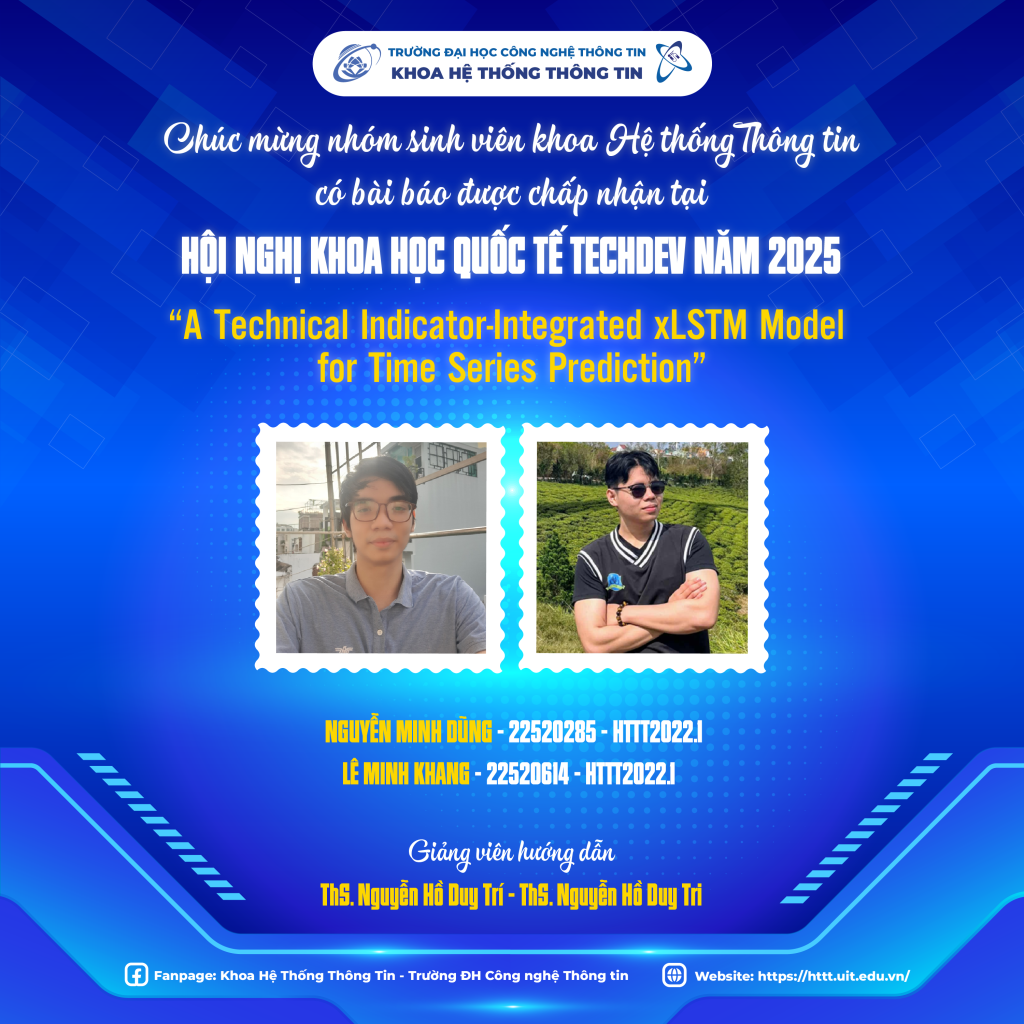
Chúc mừng sinh viên lớp HTTT2022.1 có bài báo được chấp nhận đăng tại Hội nghị Khoa học Quốc tế TechDev 2025 (The 2025 14th International Conference on Computer Technologies and Development)
Hội nghị TechDev (International Conference on Computer Technologies and Development) là một diễn đàn khoa học quốc tế quan trọng trong lĩnh vực Công nghệ Máy tính, quy tụ các nhà nghiên cứu, học giả và chuyên gia từ học thuật, công nghiệp và chính phủ. Tương lai của ngành khoa học máy tính đang được định hình bởi những công nghệ đột phá như máy tính lượng tử và công nghệ nano, mở ra khả năng xử lý song song với tốc độ vượt xa mọi giới hạn hiện tại. Trong bối cảnh này, TechDev 2025 – trước đây được biết đến với tên gọi ICCTD – tiếp tục giữ vai trò là điểm hội tụ học thuật uy tín, nơi thảo luận các tiến bộ mới nhất trong nghiên cứu và ứng dụng công nghệ.
Hội nghị năm nay bao quát các chủ đề cốt lõi như Tổ chức & Kiến trúc Máy tính, Hệ điều hành & Hệ thống phân tán, Trí tuệ nhân tạo, Khoa học tính toán, cùng những Ứng dụng và Xu hướng Công nghệ Mới. Đây là cơ hội tuyệt vời để các nhà nghiên cứu chia sẻ kết quả khoa học, mở rộng hợp tác và cùng nhau định hình tương lai của ngành.
TechDev 2025 sẽ được tổ chức trực tuyến từ ngày 08 đến 10 tháng 12 năm 2025, do đơn vị đăng cai tại Leeds, Vương quốc Anh phụ trách theo hình thức online.
Link hội nghị: https://www.icctd.org/
Tên bài báo: “A Technical Indicator-Integrated xLSTM Model for Time Series Prediction”
Nhóm sinh viên thực hiện:
- 22520614 – Lê Minh Khang – HTTT2022.1
- 22520285 – Nguyễn Minh Dũng – HTTT2022.1
Giảng viên hướng dẫn: ThS. Nguyễn Hồ Duy Trí – ThS. Nguyễn Hồ Duy Tri
Abstract:Traditional Long Short-Term Memory (LSTM) networks often struggle to effectively capture long-range dependencies and achieve optimal performance when analyzing complex financial time series. Addressing these challenges, this study proposes an improved financial forecasting model based on the recently developed extended Long Short-Term Memory architecture. Our method adapts the xLSTMTime model, utilizing its enhanced memory mechanisms—specifically sLSTM (stabilized LSTM) and mLSTM (matrix LSTM)—alongside exponential gating to better handle volatile financial data. To significantly enhance predictive power, we integrate 18 technical indicators derived from historical price data into the model, capturing essential aspects of price trends and momentum. We fine-tune the model through hyperparameter optimization and apply enhancements like series decomposition and Reversible Instance Normalization (RevIN) to ensure robustness against distribution shifts and non-stationarity. Extensive experiments conducted on historical S&P 500 index data sourced from Yahoo Finance demonstrate the efficacy of our approach. The enhanced xLSTMTime model consistently outperforms baseline models and configurations run without the technical indicators, achieving a lower Mean Absolute Percentage Error (MAPE) in both short-term and long-term forecasts. For instance, in one short-horizon setup, MAPE improved from 0.2492 to 0.2226 with the full set of features. Ablation studies confirm the crucial additive value of these technical features in boosting predictive accuracy. This work validates the potential of refined recurrent architectures in financial forecasting, offering a robust and computationally efficient alternative to transformer-based models for handling multivariate time series with long horizons.