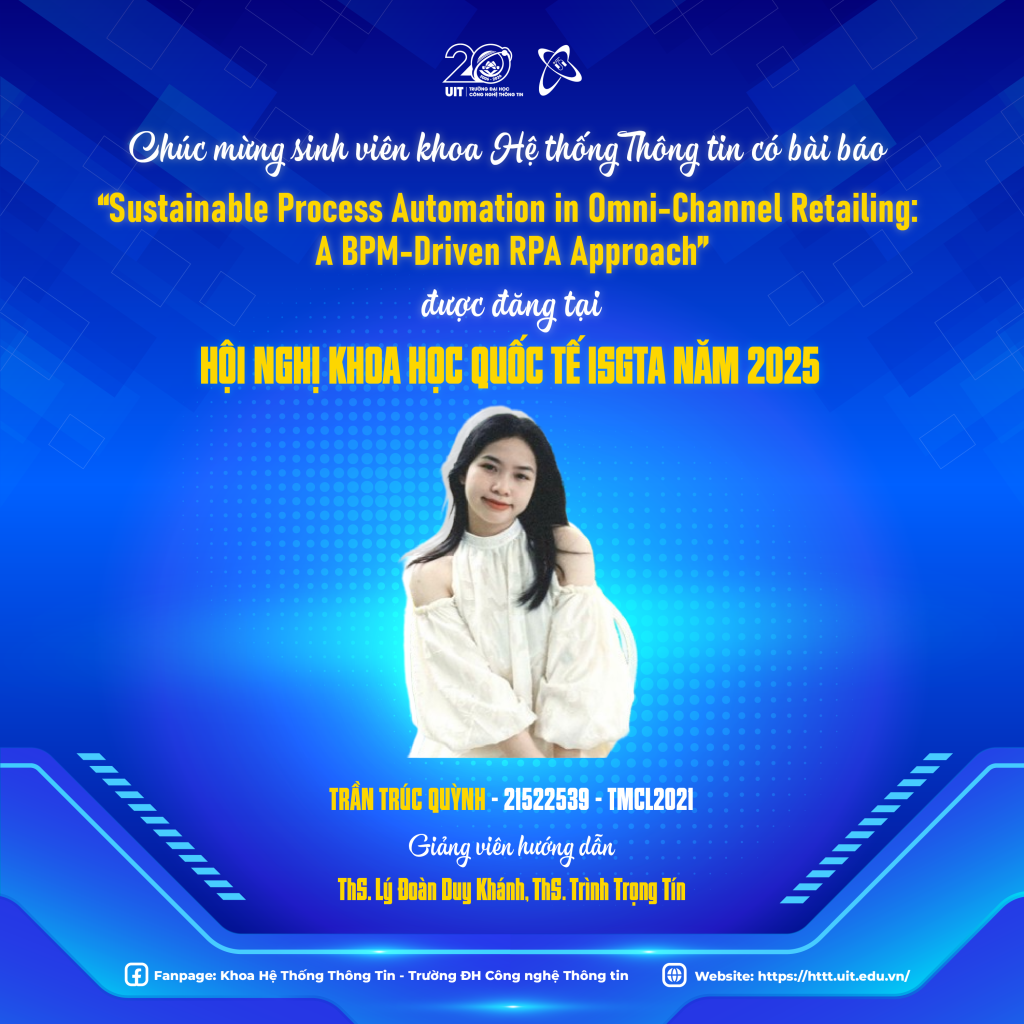
CHÚC MỪNG SINH VIÊN LỚP TMCL2021 CÓ BÀI BÁO ĐƯỢC ĐĂNG TẠI HỘI NGHỊ KHOA HỌC QUỐC TẾ ISGTA NĂM 2025
ISGTA’2025 là diễn đàn trao đổi học thuật và công nghiệp về công nghệ xanh, năng lượng tái tạo, đô thị thông minh xanh và công nghệ điện toán & mạng lưới xanh. Hội nghị tập trung vào các thách thức của việc xây dựng đô thị bền vững và đáng sống thông qua ba yếu tố cốt lõi: giảm tiêu thụ năng lượng, nâng cao chất lượng sống và thúc đẩy vai trò chủ động của người dân. Sự kiện quy tụ các nghiên cứu mới nhất về trí tuệ nhân tạo và công nghệ xanh, phù hợp cho sinh viên, nhà nghiên cứu, kỹ sư và chuyên gia quan tâm đến các tiến bộ trong lĩnh vực đô thị thông minh bền vững. Hội nghị diễn ra dưới hình thức hybrid từ ngày 19–21/11/2025 tại Portalegre, Bồ Đào Nha. Tất cả bài báo được chấp nhận sẽ được trình bày và xuất bản trong kỷ yếu hội nghị bởi Springer, được lập chỉ mục Scopus.
Thông tin chi tiết về hội nghị có thể tham khảo tại: https://isgta-conf.com
Tên bài báo: “Sustainable Process Automation in Omni-Channel Retailing: A BPM-Driven RPA Approach”
Sinh viên thực hiện: 21522539 – Trần Trúc Quỳnh – TMCL2021
Giảng viên hướng dẫn: ThS. Lý Đoàn Duy Khánh, ThS. Trình Trọng Tín
Abstract: This study explores how a Business Process Management (BPM) driven Robot-ic Process Automation (RPA) approach supports sustainable process design in omnichannel retailing. In a controlled experiment, Business Process Manage-ment (BPM) orchestrates workflows while Robotic Process Automation (RPA) executes tasks, with as is and to be processes (AS IS/TO BE) modeled using Business Process Model and Notation (BPMN). Two representative cases, or-der routing and real time inventory updating, are implemented. Performance data are compared with a manual baseline across four indicators: execution time, execution mode, service readiness, and manual involvement. Results reveal substantial gains, including faster processing, a shift to real time execu-tion, continuous service availability, and reduced human tasks. These improvements lower errors and reconciliation needs, strengthening supply chain responsiveness. By mapping the outcomes to Global Reporting Initiative (GRI) standards and interpreting them within the Triple Bottom Line (TBL) frame-work, the study demonstrates contributions not only to operational efficiency but also to the economic, social, and environmental dimensions of sustainability in the omnichannel context.