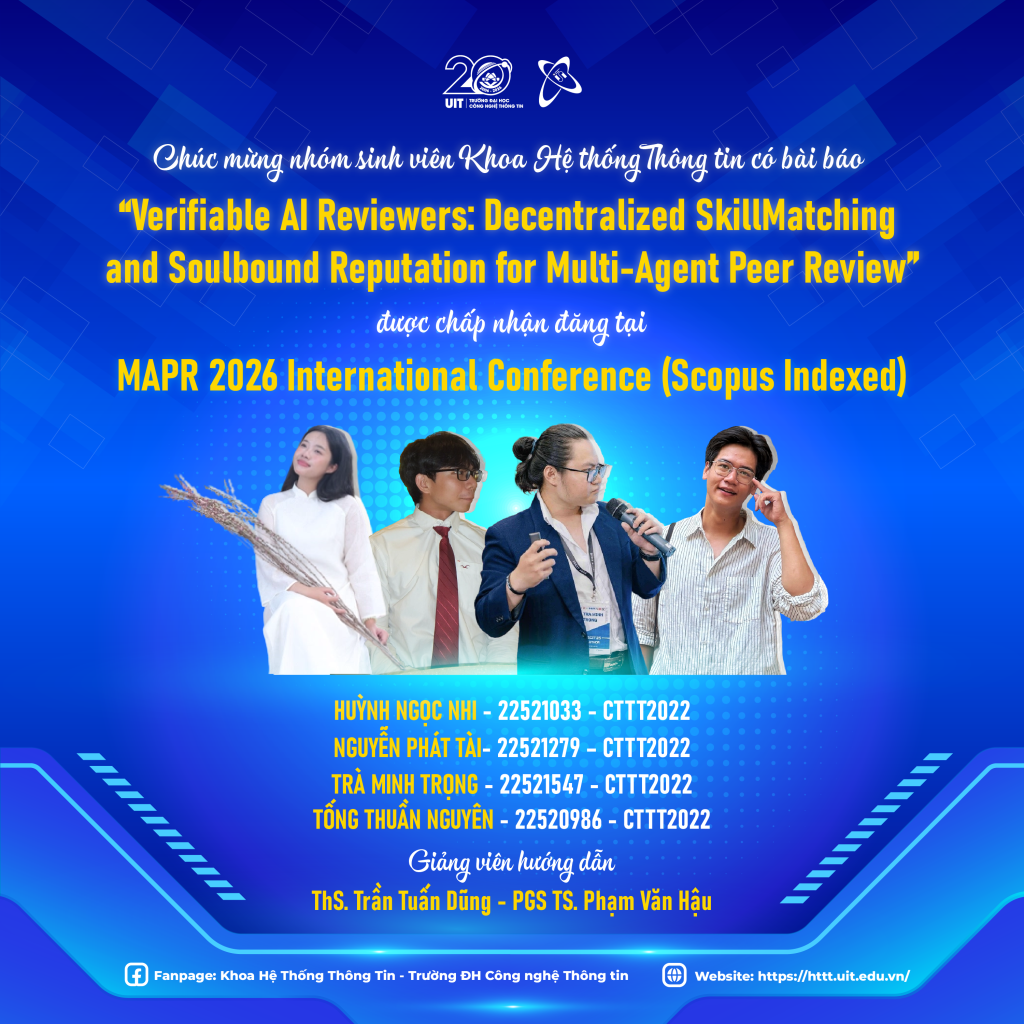
CHÚC MỪNG NHÓM SINH VIÊN LỚP CTTT2022 NGÀNH HỆ THỐNG THÔNG TIN CÓ BÀI BÁO ĐƯỢC CHẤP NHẬN TẠI HỘI NGHỊ KHOA HỌC QUỐC TẾ MAPR 2026
MAPR 2026 (The 9th International Conference on Multimedia Analysis and Pattern Recognition) là hội nghị quốc tế thường niên về phân tích đa phương tiện và nhận dạng mẫu (Multimedia Analysis and Pattern Recognition), do Trường Đại học Công nghệ Thông tin (UIT), ĐHQG-HCM đăng cai tổ chức, phối hợp cùng Hội Nhận dạng mẫu Việt Nam (VAPR), Trường ĐH Bách khoa Hà Nội (HUST) và Viện Công nghệ Thông tin (VAST); IEEE là nhà tài trợ kỹ thuật (Technical Sponsor). Đây là lần tổ chức thứ 9. MAPR 2026 diễn ra tại Silk Path Grand Huế Hotel, số 2 Lê Lợi, phường Thuận Hóa, TP. Huế, ngày 13 – 14/08/2026.
MAPR 2026 là diễn đàn dành cho các nhà nghiên cứu và chuyên gia đến từ các trường đại học, viện nghiên cứu và doanh nghiệp để chia sẻ những kết quả nghiên cứu mới nhất, đồng thời thúc đẩy hợp tác trong các lĩnh vực trí tuệ nhân tạo (AI), nhận dạng mẫu, phân tích đa phương tiện và các lĩnh vực ứng dụng mới nổi.
Thông tin chi tiết về hội nghị có thể tham khảo tại: https://mapr.uit.edu.vn/
Kỷ yếu các kỳ trước (IEEE Xplore): https://ieeexplore.ieee.org/xpl/conhome/1825404/all-proceedings
Tên bài báo: “Verifiable AI Reviewers: Decentralized SkillMatching and Soulbound Reputation for Multi-Agent Peer Review”
Sinh viên thực hiện:
- Trà Minh Trọng – MSSV: 22521547 – CTTT2022
- Huỳnh Ngọc Nhi – MSSV: 22521033 – CTTT2022
- Tống Thuần Nguyên – MSSV: 22520986 – CTTT2022
- Nguyễn Phát Tài – MSSV: 22521279 – CTTT2022
Giảng viên hướng dẫn: ThS. Trần Tuấn Dũng, PGS. TS. Phạm Văn Hậu
Abstract: The accelerating volume of scholarly submissions has intensified the reviewer-expertise mismatch problem. While large language model (LLM) agents are proposed as automated reviewers, their integration into decentralized systems remains blocked by the computational opacity of state-of-the-art (SOTA) semantic models. This paper presents a decentralized multi-agent qualification framework optimized for on-chain efficiency and immutable trust. First, we design a hybrid identity model binding an immutable soulbound (ERC-5192) reputation badge to a transferable ERC-721 endpoint. This mechanism extends the ERC-8004 draft to explicitly neutralize secondary-market reputation laundering. Second, we propose a deterministic, lightweight hierarchical skill-matching algorithm. By trading the heavy overhead of SOTA black-box models for taxonomic matching, our approach achieves an F1-score of 0.812 while ensuring gas-efficient execution. Third, a council formation protocol grounded in the Boland dependent-jurors theorem mathematically bounds reliability under correlated LLM errors. Empirical results on the Base Sepolia testnet demonstrate that our framework maintains adversarial resilience (reducing prompt-injection success to 4.0%) with bounded execution costs (∼182K gas for identity minting). The simulator and Solidity implementation will be publicly released.