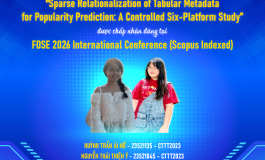
CHÚC MỪNG NHÓM SINH VIÊN KHOA HỆ THỐNG THÔNG TIN CÓ BÀI BÁO ĐƯỢC CHẤP NHẬN TẠI HỘI NGHỊ QUỐC TẾ FDSE 2026 (SCOPUS)
International Conference on Future Data and Security Engineering (FDSE) là hội nghị thường niên dành cho các nhà nghiên cứu và chuyên gia quan tâm đến những hướng nghiên cứu và ứng dụng mới trong lĩnh vực dữ liệu, thông tin, tri thức và kỹ thuật an toàn. Hội nghị là nơi các nhà nghiên cứu và chuyên gia trình bày, trao đổi các kết quả nghiên cứu, các ứng dụng dựa trên dữ liệu cũng như thảo luận những vấn đề và định hướng nghiên cứu mới trong tương lai.
FDSE 2026 sẽ được tổ chức tại Trường Đại học Khoa học Tự Nhiên ĐHQG-HCM, Thành phố Hồ Chí Minh, Việt Nam vào ngày 26 – 27/11/2026. Proceedings của hội nghị được chỉ mục tại Scopus, EI Compendex, DBLP và Conference Proceedings Citation Index (CPCI).
Các bài báo được chấp nhận tại FDSE 2026 sẽ được xuất bản bởi Springer Verlag trong series Communications in Computer and Information Science (CCIS).
Thông tin Hội nghị: https://thefdse.org/
Mã ISSN: 1865-0929
Tên bài báo: “Auditing Graph Signal in Supply-Chain Demand Forecasting: A Three-Level Diagnostic Framework and Case Study on the SG-24 Dataset”
Sinh viên thực hiện:
- Tống Thuần Nguyên – MSSV 22520986 – CTTT2022
- Phạm Lê Anh Thúy – MSSV 22521458 – CTTT2022
Giảng viên hướng dẫn: TS. Trần Hưng Nghiệp
Abstract: Graph-aware supply-chain forecasting is appealing because products share plants, storage locations, categories, and demand dynamics. Yet a higher score for a graph-aware model does not by itself show that the graph contributed useful relational information: gains may also reflect leakage, weak tabular baselines, added covariates, split effects, or smoothing from dense projections. Conventional score comparisons therefore conflate three distinct claims: that a model uses graph-derived information, that this information improves forecasts beyond a matched non-graph reference, and that the improvement depends on the observed graph rather than an arbitrary structure. We propose a reusable three-level diagnostic framework that separates these claims as utilization, incremental predictive utility, and structural specificity. It combines usage diagnostics with leakage-safe matched controls, paired temporal uncertainty, and random, rewired, and permuted-neighbor controls, making the evidence required for graph-utility claims explicit. We instantiate the framework on SupplyGraph 2024 (SG-24) cite{supplygraph2024}, a small benchmark of 40 products and 221 days. Graph-derived variables influence fitted predictions and improve forecasts in selected settings, but the gains depend on tuning, horizon, and graph density and do not consistently separate from null graph controls. These dataset-specific findings motivate multi-dataset validation. The main contribution is the diagnostic framework; the SG-24 case study shows how it separates graph usage, predictive utility, and structural specificity before graph-based demand-forecasting claims are treated as supported.