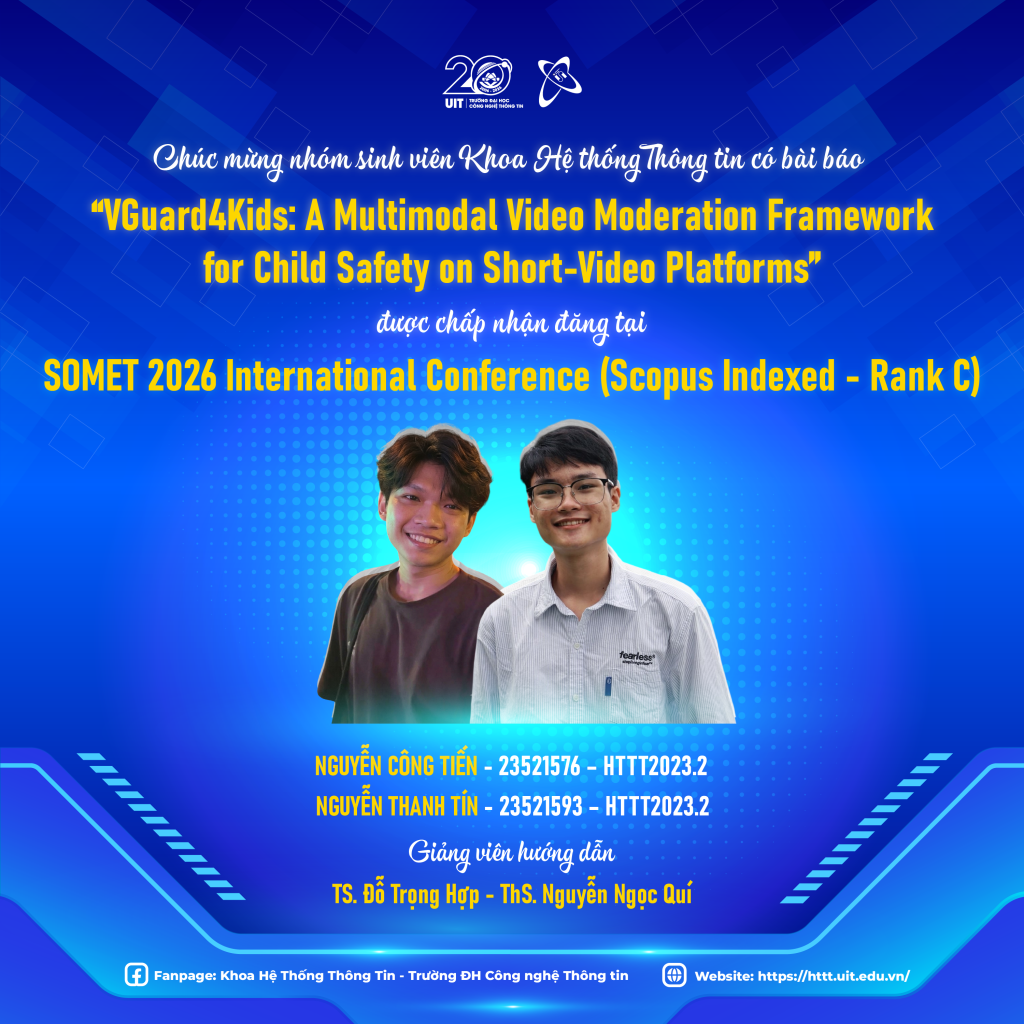
CHÚC MỪNG NHÓM SINH VIÊN LỚP HTTT2023.2 CÓ BÀI BÁO ĐƯỢC CHẤP NHẬN TẠI HỘI NGHỊ KHOA HỌC QUỐC TẾ SOMET 2026 (SCOPUS – RANK C)
SOMET 2026 – International Conference on Intelligent Software Methodologies, Tools, and Techniques là hội nghị quốc tế tập trung vào các phương pháp luận, công cụ và kỹ thuật mới trong lĩnh vực Kỹ thuật Phần mềm. Hội nghị là diễn đàn để các nhà nghiên cứu, chuyên gia và cộng đồng học thuật trao đổi những kết quả nghiên cứu, ý tưởng mới và kinh nghiệm thực tiễn, đồng thời thảo luận về các vấn đề và thách thức đang đặt ra trong quá trình phát triển phần mềm.
SOMET đặc biệt quan tâm đến những hướng nghiên cứu về kỹ thuật phần mềm thông minh, các phương pháp và công cụ hỗ trợ phát triển phần mềm, cũng như sự kết nối giữa nền tảng lý thuyết và các ứng dụng thực tiễn. Qua đó, hội nghị góp phần thúc đẩy những hướng phát triển mới trong lĩnh vực Kỹ thuật Phần mềm và các công nghệ liên quan.
SOMET 2026 được tổ chức từ ngày 09 đến ngày 11 tháng 09 năm 2026 tại Kuala Lumpur, Malaysia, với sự tham gia của cộng đồng nghiên cứu và chuyên gia trong lĩnh vực Kỹ thuật Phần mềm trên thế giới.
Thông tin chi tiết về hội nghị có thể tham khảo tại: https://www.i-somet.org/somet2026/index.html
Tên bài báo: “VGuard4Kids: A Multimodal Video Moderation Framework for Child Safety on Short-Video Platforms”
Sinh viên thực hiện:
- Nguyễn Thanh Tín – 23521593 – HTTT2023.2
- Nguyễn Công Tiến – 23521576 – HTTT2023.2
Giảng viên hướng dẫn:TS. Đỗ Trọng Hợp, ThS. Nguyễn Ngọc Quí
Abstract: The rapid growth of TikTok, YouTube Shorts, and YouTube has increased the need to protect children from inappropriate content on online video platforms. However, existing approaches remain limited because they often rely on a single modality, provide insufficient support for Vietnamese, and are difficult to deploy in resource-constrained environments. This paper presents VGuard4Kids, an end-to-end multimodal framework for detecting harmful video content for children. The system combines frame-based visual features and transcript-based textual features, and employs attention-based pooling together with two fusion strategies, namely Gated Fusion and Attention Fusion, to better capture video context. From a deployment perspective, the framework is implemented as a microservices-based architecture with a unified pipeline for data collection, preprocessing, training, and inference. Experiments on ViHarm4Kids, a Vietnamese video dataset of 6,537 videos annotated with four classes (Safe, Aggressive, Sexual, and Superstition), show that the Ultra-Light mode achieves 81.90% accuracy under a 16 GB RAM, no-GPU setting, while the Balanced mode makes better use of Vietnamese textual signals. These results indicate that the proposed framework has strong potential for practical use in child-safety-oriented video moderation systems. The dataset and source code are publicly available for research purposes.