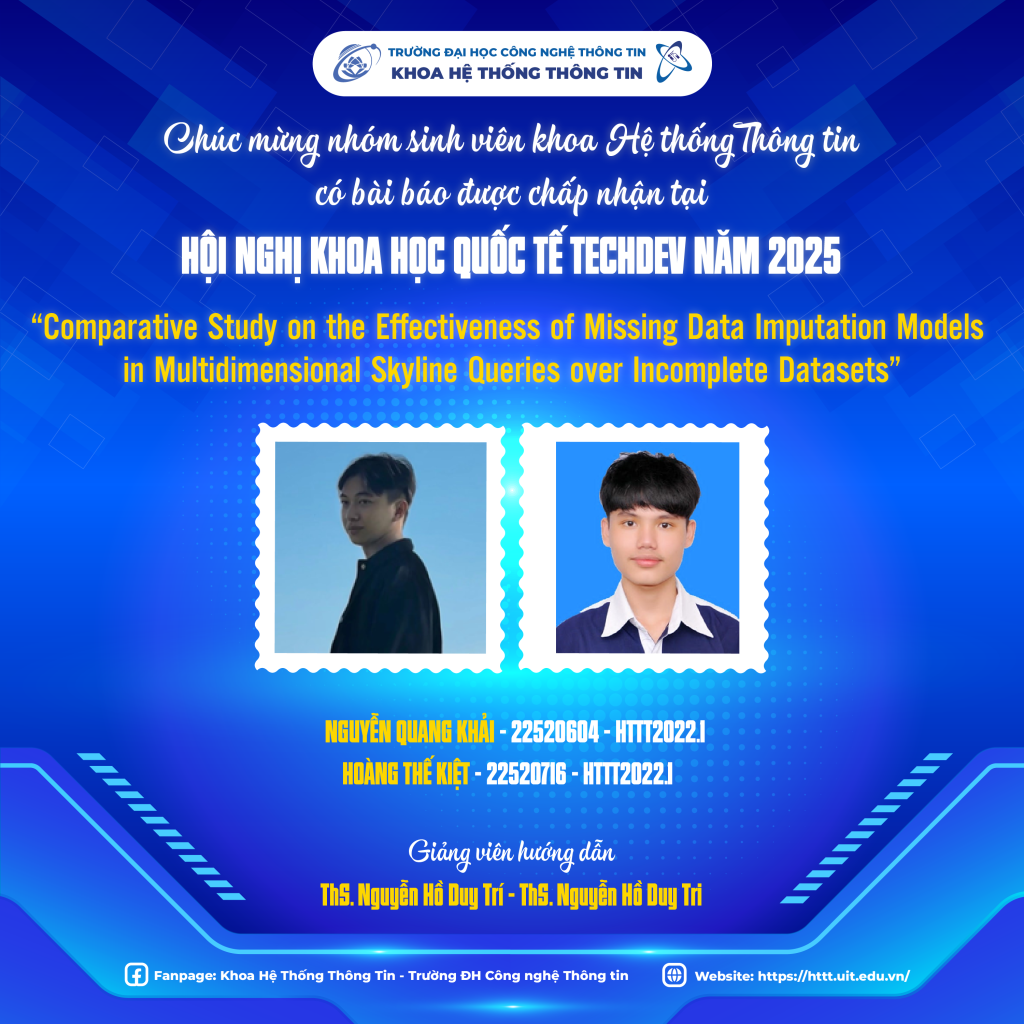
Chúc mừng sinh viên lớp HTTT2022.1 có bài báo được chấp nhận đăng tại Hội nghị Khoa học Quốc tế TechDev 2025 (The 2025 14th International Conference on Computer Technologies and Development)
Hội nghị TechDev (International Conference on Computer Technologies and Development) là một diễn đàn khoa học quốc tế quan trọng trong lĩnh vực Công nghệ Máy tính, quy tụ các nhà nghiên cứu, học giả và chuyên gia từ học thuật, công nghiệp và chính phủ. Tương lai của ngành khoa học máy tính đang được định hình bởi những công nghệ đột phá như máy tính lượng tử và công nghệ nano, mở ra khả năng xử lý song song với tốc độ vượt xa mọi giới hạn hiện tại. Trong bối cảnh này, TechDev 2025 – trước đây được biết đến với tên gọi ICCTD – tiếp tục giữ vai trò là điểm hội tụ học thuật uy tín, nơi thảo luận các tiến bộ mới nhất trong nghiên cứu và ứng dụng công nghệ.
Hội nghị năm nay bao quát các chủ đề cốt lõi như Tổ chức & Kiến trúc Máy tính, Hệ điều hành & Hệ thống phân tán, Trí tuệ nhân tạo, Khoa học tính toán, cùng những Ứng dụng và Xu hướng Công nghệ Mới. Đây là cơ hội tuyệt vời để các nhà nghiên cứu chia sẻ kết quả khoa học, mở rộng hợp tác và cùng nhau định hình tương lai của ngành.
TechDev 2025 sẽ được tổ chức trực tuyến từ ngày 08 đến 10 tháng 12 năm 2025, do đơn vị đăng cai tại Leeds, Vương quốc Anh phụ trách theo hình thức online.
Link hội nghị: https://www.icctd.org/
Tên bài báo: “Comparative Study on the Effectiveness of Missing Data Imputation Models in Multidimensional Skyline Queries over Incomplete Datasets”
Nhóm sinh viên thực hiện:
- 22520716 – Hoàng Thế Kiệt – HTTT2022.1
- 22520604 – Nguyễn Quang Khải – HTTT2022.1
Giảng viên hướng dẫn: ThS. Nguyễn Hồ Duy Trí – ThS. Nguyễn Hồ Duy Tri
Abstract: In multidimensional Skyline queries, the presence of missing values can distort the Skyline boundary and reduce the accuracy of query results. This study proposes a comparative approach using three popular data imputation models—Random Forest, XGBoost, and CatBoost—to recover missing values prior to Skyline computation. The proposed method is applied to datasets of different sizes to evaluate each models scalability and stability. Experimental results show that all three machine learning models significantly improve Skyline quality compared to processing incomplete data. Among them, Random Forest demonstrates the highest consistency across dataset scales, CatBoost achieves a balanced trade-off between accuracy and stability, while XGBoost shows notable improvements in the Jaccard and F1 metrics compared to the Possible Skyline approach—atraditional method that estimates the Skyline boundary using possible value ranges of missing attributes without performing actual imputation. This research contributes to identifying the optimal imputation model for Skyline queries over incomplete datasets and provides empirical evidence to support model selection in large-scale decision-support systems.