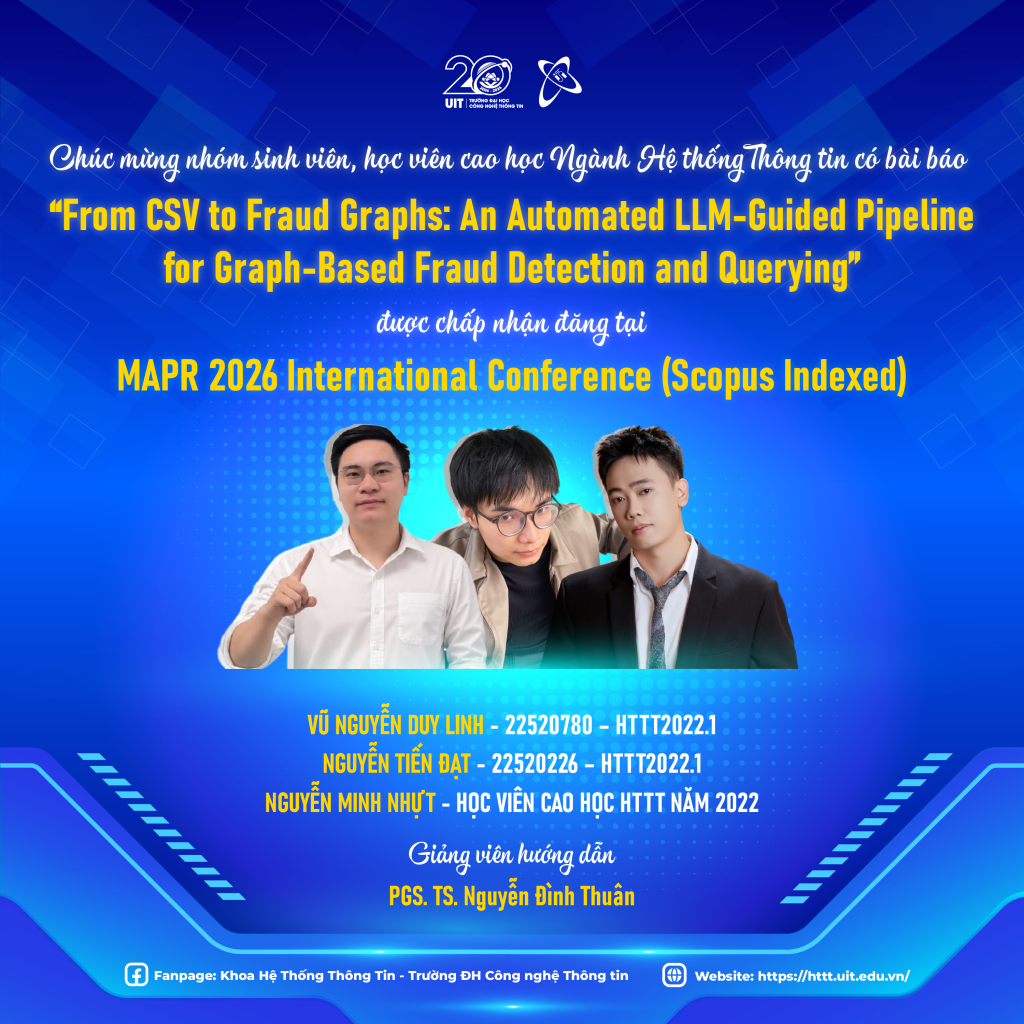
CHÚC MỪNG NHÓM SINH VIÊN LỚP HTTT2022.1 VÀ HỌC VIÊN CAO HỌC NGÀNH HỆ THỐNG THÔNG TIN CÓ BÀI BÁO ĐƯỢC CHẤP NHẬN TẠI HỘI NGHỊ KHOA HỌC QUỐC TẾ MAPR 2026
MAPR 2026 (The 9th International Conference on Multimedia Analysis and Pattern Recognition) là hội nghị quốc tế thường niên về phân tích đa phương tiện và nhận dạng mẫu (Multimedia Analysis and Pattern Recognition), do Trường Đại học Công nghệ Thông tin (UIT), ĐHQG-HCM đăng cai tổ chức, phối hợp cùng Hội Nhận dạng mẫu Việt Nam (VAPR), Trường ĐH Bách khoa Hà Nội (HUST) và Viện Công nghệ Thông tin (VAST); IEEE là nhà tài trợ kỹ thuật (Technical Sponsor). Đây là lần tổ chức thứ 9. MAPR 2026 diễn ra tại Silk Path Grand Huế Hotel, số 2 Lê Lợi, phường Thuận Hóa, TP. Huế, ngày 13 – 14/08/2026.
MAPR 2026 là diễn đàn dành cho các nhà nghiên cứu và chuyên gia đến từ các trường đại học, viện nghiên cứu và doanh nghiệp để chia sẻ những kết quả nghiên cứu mới nhất, đồng thời thúc đẩy hợp tác trong các lĩnh vực trí tuệ nhân tạo (AI), nhận dạng mẫu, phân tích đa phương tiện và các lĩnh vực ứng dụng mới nổi.
Thông tin chi tiết về hội nghị có thể tham khảo tại: https://mapr.uit.edu.vn/
Kỷ yếu các kỳ trước (IEEE Xplore): https://ieeexplore.ieee.org/xpl/conhome/1825404/all-proceedings
Tên bài báo: “From CSV to Fraud Graphs: An Automated LLM-Guided Pipeline for Graph-Based Fraud Detection and Querying”
Sinh viên và học viên thực hiện:
- Nguyễn Tiến Đạt (MSSV: 22520226) – Lớp HTTT2022.1
- Vũ Nguyễn Duy Linh (MSSV: 22520780) – Lớp HTTT2022.1
- Nguyễn Minh Nhựt – Học viên Cao học ngành Hệ thống Thông tin khóa 2022
Giảng viên hướng dẫn: PGS. TS. Nguyễn Đình Thuân
Abstract:Graph-based fraud detection can capture relational dependencies among suspicious transactions, but constructing graph representations from raw CSV files and querying the resulting graph database still require substantial schema engi neering. We propose an end-to-end framework that uses a small language model (SLM) to interpret tabular columns, construct star-topology transaction graphs, train graph neural networks for fraud detection, and support natural-language graph querying through Neo4j. The pipeline classifies columns into identifier, relation, feature, and exclusion roles and applies a leakage aware preprocessing procedure before graph construction. Fraud detection is performed with established GNN baselines and F-GNN, which is used as an existing frequency-aware backbone rather than a new model contribution. The same schema information is reused by a schema-aware Text2Cypher workflow that combines draft based schema linking with iterative execution-based self-correction. Experiments on two real-world fraud datasets show that F-GNN achieves the highest AUC and F1-Macro among the evaluated baselines on the automatically constructed graphs. On the Neo4j Text2Cypher benchmark, the complete workflow improves the correct-query rate of Qwen2-7B-Instruct from 13.35% to 18.44% on the full view and from 22.19% to 31.82% on alias-bearing queries, while reducing invalid queries from 13.39% to 4.86% and from 26.19% to 9.51%, respectively.