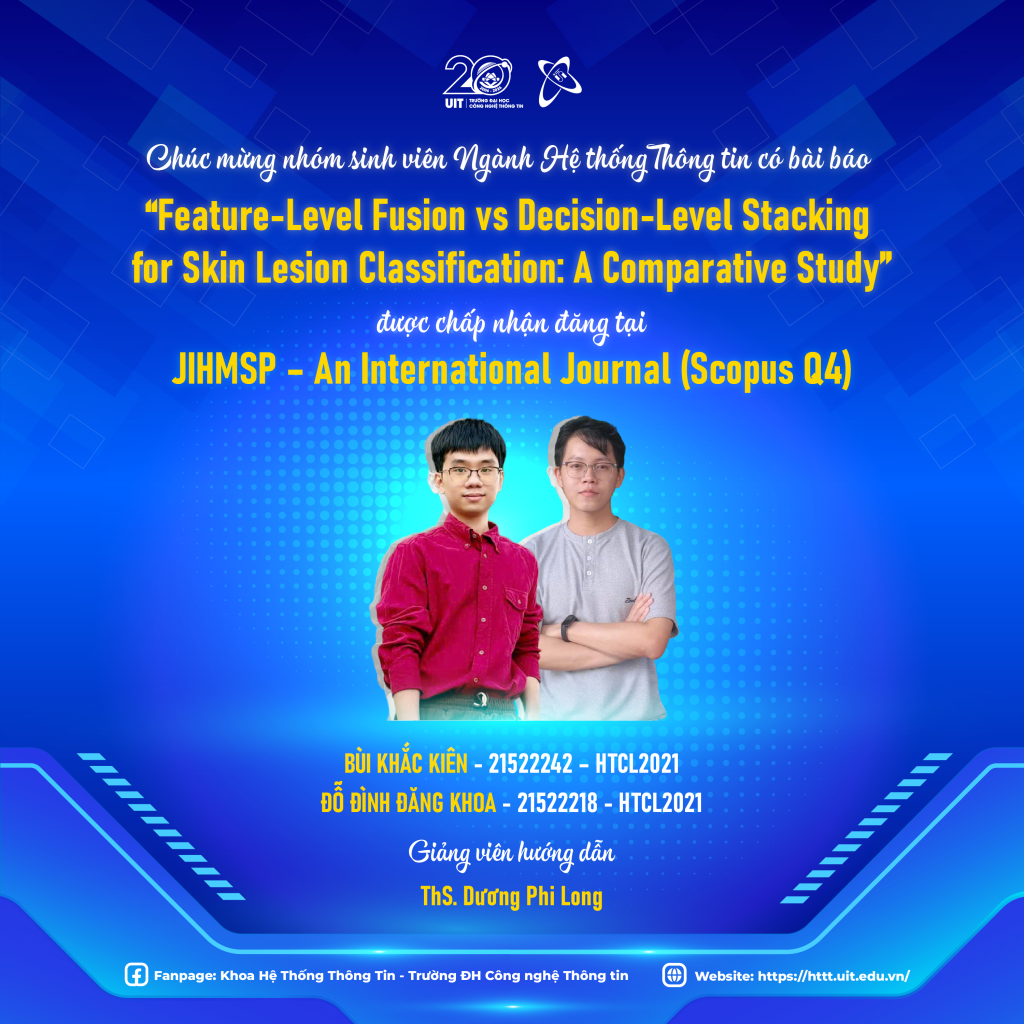
CHÚC MỪNG NHÓM SINH VIÊN LỚP HTCL2021 NGÀNH HỆ THỐNG THÔNG TIN CÓ BÀI BÁO ĐƯỢC CHẤP NHẬN ĐĂNG TẠI TẠP CHÍ KHOA HỌC QUỐC TẾ JIHMSP (Q4)
Journal of Information Hiding and Multimedia Signal Processing (JIHMSP) – tạp chí khoa học quốc tế thuộc danh mục Scopus Q4, xuất bản bởi Ubiquitous International.
JIHMSP là tạp chí khoa học quốc tế có phản biện (peer-reviewed), công bố các nghiên cứu trong nhiều lĩnh vực như Information Hiding, Multimedia Signal Processing, Image Processing, Computer Vision, Artificial Intelligence, Machine Learning và các hướng nghiên cứu liên quan. Tạp chí được lập chỉ mục trong cơ sở dữ liệu Scopus với ISSN: 2073-4212.
Thông tin tạp chí: https://bit.kuas.edu.tw/
Tên bài báo: “Feature-Level Fusion vs Decision-Level Stacking for Skin Lesion Classification: A Comparative Study”
Sinh viên thực hiện:
- Bùi Khắc Kiên – MSSV: 21522242 – Lớp HTCL2021
- Đỗ Đình Đăng Khoa – MSSV: 21522218 – Lớp HTCL2021
Giảng viên hướng dẫn: ThS. Dương Phi Long
Abstract: Skin disease diagnosis from visual inspection remains challenging due to high inter-class similarity, class imbalance, and limited access to dermatology expertise. Although deep learning models have achieved promising results, single-model approaches often lack robustness when dealing with diverse lesion patterns and minority classes. This paper presents a systematic comparison of two ensemble strategies for multi-class skin disease classification: a feature-level fusion model and a decision-level stacking model. The feature-level approach integrates ConvNeXt-Base and Vision Transformer (ViT) to capture complementary local and global representations, while the decision-level model aggregates prediction probabilities from ConvNeXt-Base and EfficientNetV2-S using a LightGBM meta-learner. Experiments are conducted on a dataset of 27,153 dermatological images across ten disease categories. Results show that the feature-level fusion model outperforms the stacking ensemble across most classes, achieving an accuracy of 85.16% and a weighted F1-score of 84.99%. In particular, the fusion model improves performance on clinically important classes such as Melanoma and Basal Cell Carcinoma, and demonstrates enhanced robustness on visually similar inflammatory conditions. These findings indicate that feature-level integration of complementary representations is more effective than decision-level aggregation for handling inter-class similarity and class imbalance in skin lesion classification. The proposed approach provides a practical direction for improving the reliability of AI-assisted dermatological diagnosis.