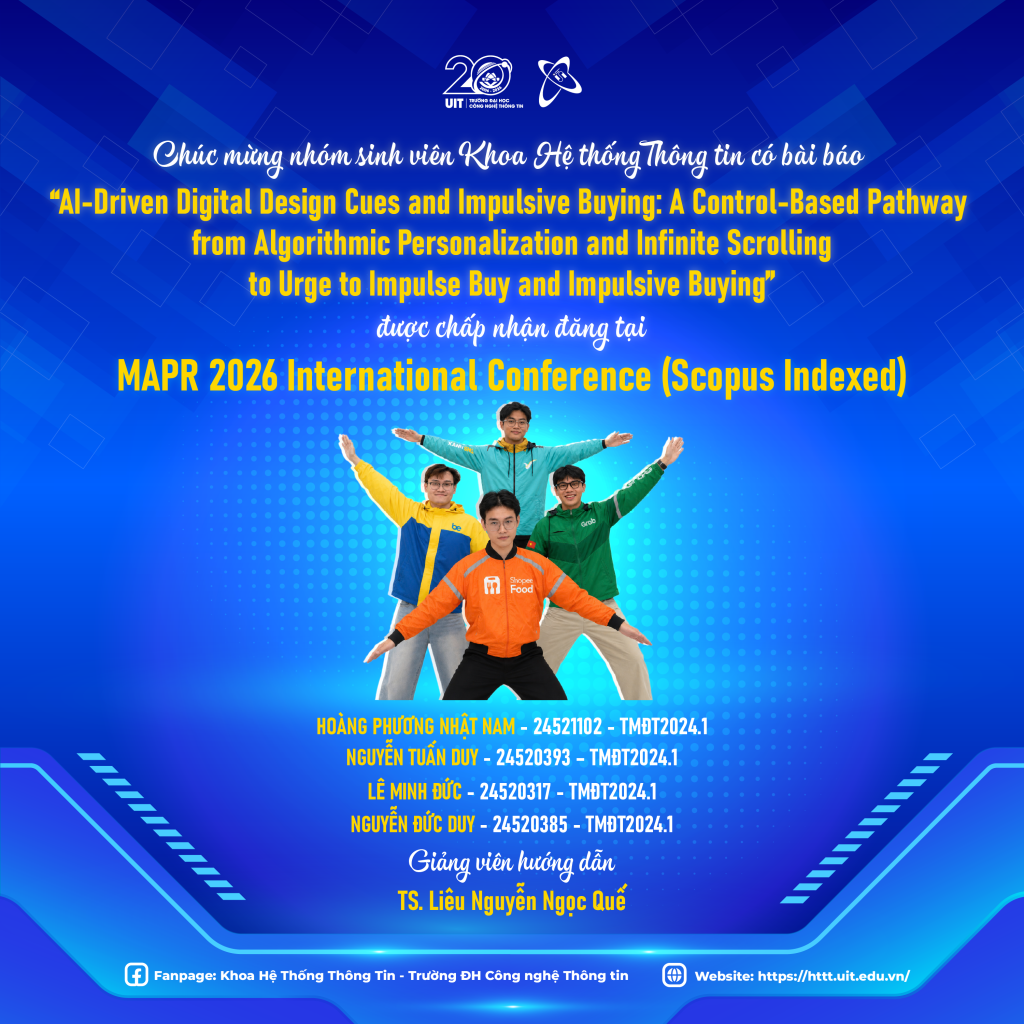
CHÚC MỪNG NHÓM SINH VIÊN LỚP TMĐT2024.1 KHOA HỆ THỐNG THÔNG TIN CÓ BÀI BÁO ĐƯỢC CHẤP NHẬN TẠI HỘI NGHỊ KHOA HỌC QUỐC TẾ MAPR 2026
MAPR 2026 (The 9th International Conference on Multimedia Analysis and Pattern Recognition) là hội nghị quốc tế thường niên về phân tích đa phương tiện và nhận dạng mẫu (Multimedia Analysis and Pattern Recognition), do Trường Đại học Công nghệ Thông tin (UIT), ĐHQG-HCM đăng cai tổ chức, phối hợp cùng Hội Nhận dạng mẫu Việt Nam (VAPR), Trường ĐH Bách khoa Hà Nội (HUST) và Viện Công nghệ Thông tin (VAST); IEEE là nhà tài trợ kỹ thuật (Technical Sponsor). Đây là lần tổ chức thứ 9. MAPR 2026 diễn ra tại Silk Path Grand Huế Hotel, số 2 Lê Lợi, phường Thuận Hóa, TP. Huế, ngày 13 – 14/08/2026.
MAPR 2026 là diễn đàn dành cho các nhà nghiên cứu và chuyên gia đến từ các trường đại học, viện nghiên cứu và doanh nghiệp để chia sẻ những kết quả nghiên cứu mới nhất, đồng thời thúc đẩy hợp tác trong các lĩnh vực trí tuệ nhân tạo (AI), nhận dạng mẫu, phân tích đa phương tiện và các lĩnh vực ứng dụng mới nổi.
Thông tin chi tiết về hội nghị có thể tham khảo tại: https://mapr.uit.edu.vn/
Kỷ yếu các kỳ trước (IEEE Xplore): https://ieeexplore.ieee.org/xpl/conhome/1825404/all-proceedings
Tên bài báo: “AI-Driven Digital Design Cues and Impulsive Buying: A Control-Based Pathway from Algorithmic Personalization and Infinite Scrolling to Urge to Impulse Buy and Impulsive Buying”
Sinh viên thực hiện:
- Hoàng Phương Nhật Nam – MSSV: 24521102 – Lớp TMĐT2024.1
- Nguyễn Tuấn Duy – MSSV: 24520393 – Lớp TMĐT2024.1
- Lê Minh Đức – MSSV: 24520317 – Lớp TMĐT2024.1
- Nguyễn Đức Duy – MSSV: 24520385 – Lớp TMĐT2024.1
Giảng viên hướng dẫn: TS. Liêu Nguyễn Ngọc Quế
Abstract: AI-enabled shopping feeds combine algorithmic personalization (AP) with infinite scrolling (IS), yet their joint influence on user agency and impulsive buying remains under-specified. This study develops and tests a control-based stimulus-organism-response model in which AP and IS are associated with perceived loss of control (PLC), which in turn is linked to urge to impulse buy (UIB) and impulsive buying (IB). Survey data from 602 Vietnamese e-commerce users were analyzed using reliability testing, exploratory factor analysis, staged regression, robustness checks, and a 5,000-replication parametric bootstrap based on the observed covariance structure. AP and IS were positively associated with PLC (β = .293 and .328, respectively; p < .001), PLC was associated with UIB (β = .321, p < .001), and UIB was associated with IB (β = .204, p < .001). Both serial indirect effects had confidence intervals excluding zero, while AP retained only a small direct association with IB and the direct IS–IB path was not significant. The findings distinguish AP as a relevance-shaping cue from IS as an exposure-continuity cue and identify practical implications for stopping cues, reset points, and explainable personalization controls. Because the evidence is cross-sectional and self-reported, the results are interpreted as patterned associations rather than causal effects.