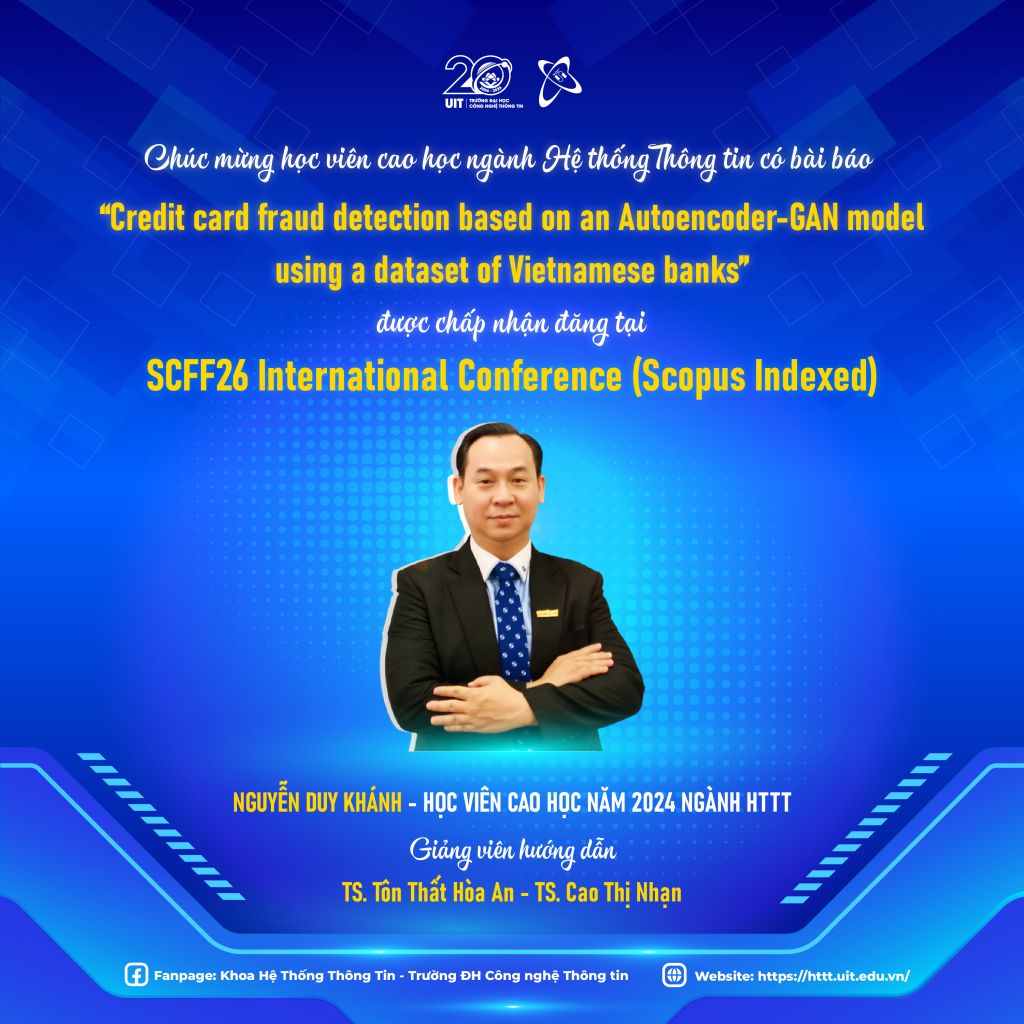
CHÚC MỪNG HỌC VIÊN CAO HỌC NGÀNH HỆ THỐNG THÔNG TIN CÓ BÀI BÁO ĐƯỢC CHẤP NHẬN TẠI HỘI NGHỊ KHOA HỌC QUỐC TẾ SCFF26
The 4th International Conference on From Smart Cities to Smart Factories for a Sustainable Future (SCFF26) là hội nghị khoa học quốc tế lần thứ 4 với chủ đề “From Smart Cities to Smart Factories for a Sustainable Future”, tập trung vào các hướng nghiên cứu về trí tuệ nhân tạo (AI), học máy (Machine Learning), dữ liệu lớn (Big Data), chuyển đổi số, sản xuất thông minh và phát triển bền vững. Hội nghị được đồng tổ chức bởi VSB – Technical University of Ostrava (Cộng hòa Séc) và Trường Đại học Tài chính – Marketing (UFM), tạo diễn đàn để các nhà khoa học, giảng viên và chuyên gia trong và ngoài nước trao đổi các kết quả nghiên cứu mới, đồng thời thúc đẩy hợp tác nghiên cứu quốc tế.
SCFF26 sẽ diễn ra tại Thành phố Hồ Chí Minh trong hai ngày 13–14/05/2026. Các bài báo được chấp nhận sẽ được xuất bản trong bộ sách Lecture Notes in Networks and Systems (Springer) thuộc danh mục Scopus; một số bài báo xuất sắc còn có cơ hội được đề cử công bố trên MM Science Journal (Scopus và Web of Science).
Thông tin chi tiết về hội nghị: https://fds.ufm.edu.vn/scff26-73.html
Tên bài báo: “Credit Card Fraud Detection Based on an Autoencoder-GAN Model Using a Dataset of Vietnamese Banks”
Học viên thực hiện:
- Nguyễn Duy Khánh – Học viên Cao học ngành Hệ thống Thông tin, Khóa 2024
Giảng viên hướng dẫn:TS. Tôn Thất Hòa An và TS. Cao Thị Nhạn
Abstract: Credit card fraud detection in banks faces many challenges due to severely imbalanced transaction data and a lack of reliable fraud labels. In this context, model evaluation needs to be based on empirical evidence reflecting behavioral structure and data distribution, rather than relying solely on traditional classification indices. This study proposes an unsupervised deep learning model integrating an Autoencoder and Generative Adversarial Network (AE-GAN) to learn and simulate abnormal transaction behavior. The Autoencoder is trained on normal transaction data to learn the underlying behavioral structure, where reproduction error and latent space are used to identify abnormal transactions. This model is experimentally tested on a dataset of Vietnamese banks to contribute a benchmark study in addressing this problem.